Most brands are spending more on PPC because their listing structure is invisible to Amazon's AI. The problem is not the product. It is the architecture the system cannot read.
Most brands only discover this when PPC costs start climbing without explanation. By then, the algorithm has already decided where your listing belongs — and it is rarely where you think.
The problem is not the product. It is not the ads. It is the architecture the system cannot read. And it has been invisible since the listing went live.
Rufus evaluates semantic relevance before any buyer sees your product. If the architecture is not built for both — you pay for every click the algorithm will not give you for free.
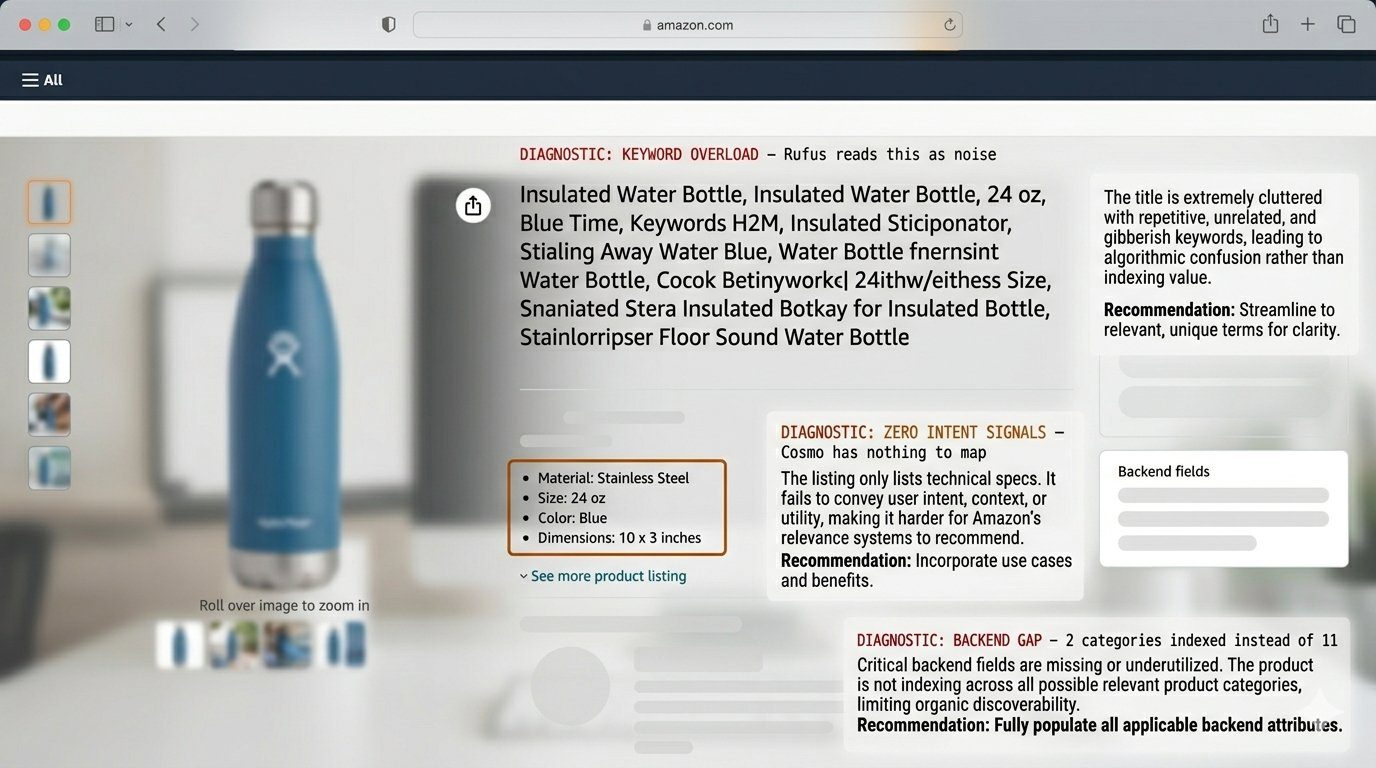
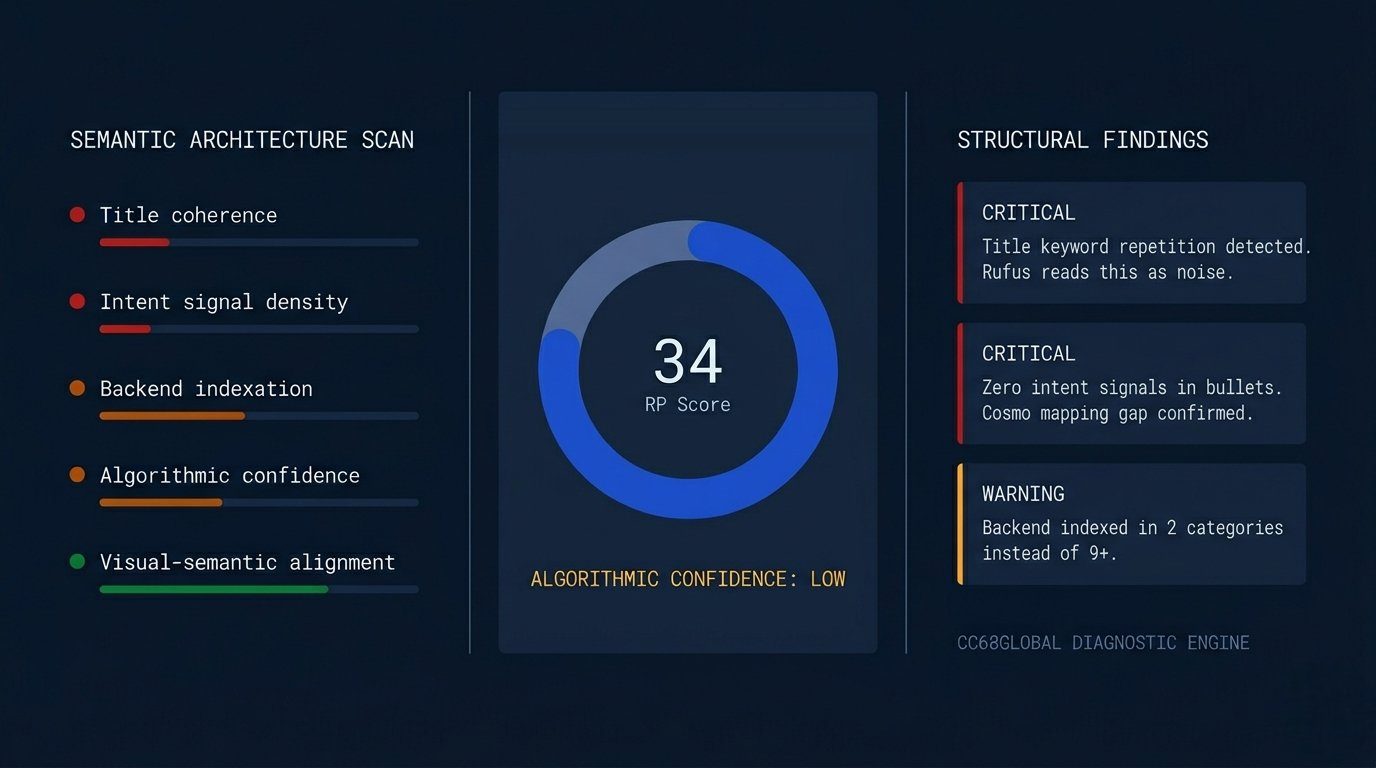
The listing above shows three structural failures visible in under 8 minutes. Keyword overload in the title. Zero intent signals in the bullets. Backend indexed in 2 categories instead of 11.
Good product. Real revenue. Invisible to the system that decides who sees it. That is not a copy problem. That is an architecture problem.
Before a single buyer sees them. Before a single ad runs. The architecture is already broken.
The system has already decided where to place them. And it is not where the seller thinks.
Most listings do not fail because of the product. They fail because the system does not know where to put them.
Each protocol is calibrated to a specific stage of the architectural failure — from rapid diagnosis to full semantic reconstruction. The difference between a listing that exists and one the system actively recommends is structural.
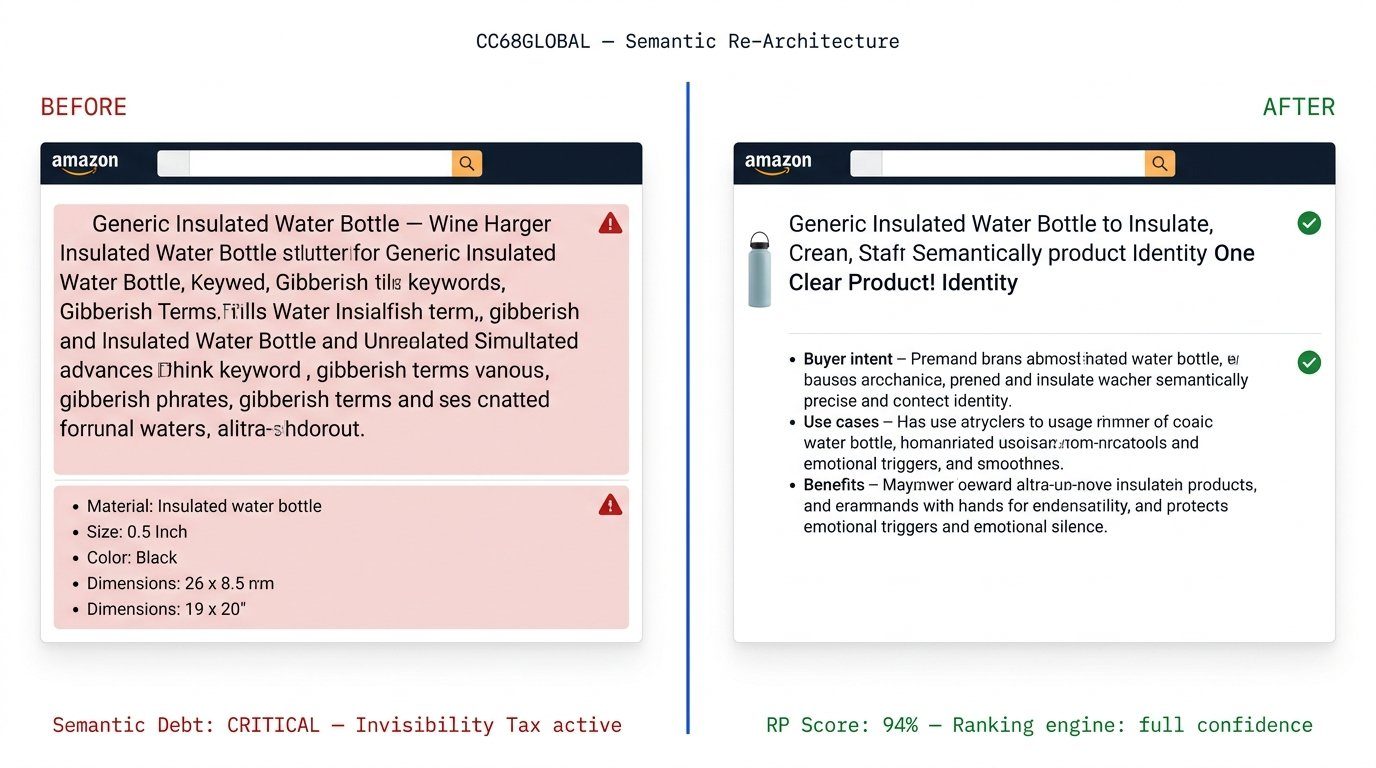
Before: Semantic Debt critical — Ambiguity Tax active
After: RP Score 94% — Ranking engine at full confidence
My professional background is not in marketing. It is in precision technology.
For years I worked at the intersection of applied physics, optical engineering and medical technology — sectors where the margin for error is zero, where every process follows a protocol, and where results are always measurable. I trained directly with manufacturers, understood equipment at component level, and built the discipline of diagnosing before acting.
I managed sales teams, directed commercial operations across multiple markets, and led sourcing strategies with international partners. In every role, the same principle applied: you cannot optimise what you do not fully understand.
Ten years ago I made a deliberate decision to start from zero in eCommerce. Not as a side project — as a full commitment. I began by mastering high-performance media buying — learning how digital traffic works, how spend converts, and how platforms reward or punish the decisions sellers make. That foundation taught me something critical: the most expensive traffic in the world cannot save a listing the algorithm does not understand.
When I went deep into Amazon FBA and its AI ecosystem, I brought the same precision framework I had built over three decades. Not “how do I write a better listing” — but “how does the system actually read it, how does it decide where to place it, and what is making it invisible.”
Most people treat Amazon as a marketplace. I treat it as a technical system with its own physics — its own language, logic and failure modes. That is what CC68GLOBAL is built on.
I diagnose why listings with strong products and real revenue still lose visibility — and I rebuild the architecture that makes Amazon's AI understand what it is selling. The result is not better copy. It is a listing the system was built to recommend.
This is not a volume service. It is not an agency model. It is a specialist intervention — the kind that requires a human architect, a structured protocol, and the discipline to diagnose before acting.
Most brands that contact us already know something is wrong. They just do not know where.
These are not hypothetical. They are structural patterns identified repeatedly across audited listings — in categories ranging from Home & Kitchen to Health & Personal Care, at revenue levels from $20K to $200K/month. The product is never the problem. The architecture is.
The seller adds more keywords believing broader coverage means greater visibility. The outcome is the opposite. Rufus interprets high keyword density as a signal of low semantic coherence — the listing cannot identify what it is. Algorithmic confidence drops. The system deprioritises the listing in purchase-intent queries. The seller detects falling organic traffic and adds more keywords. The cycle compounds.
The backend search terms are clean — no repetition, no irrelevant terms, no formatting errors. By every standard guide, it is correctly built. The problem is not what is there. It is what is missing. With 80 bytes of 250 available utilised, the ranking engine indexes the listing across 2 to 3 categories instead of 11 to 14. The seller never detects it because the listing ranks for its core keywords. The remaining 80% of applicable placement opportunities are simply never activated.
The bullet points are technically precise. Material, dimensions, certifications, compatibility. Everything accurate, everything verifiable. Cosmo reads the bullets looking for purchase intent signals — use cases, decision contexts, problems the product resolves. It finds none. Without intent architecture, the listing cannot be matched to the conversational queries Rufus evaluates in real time. The product exists in the catalogue. It does not exist in the recommendation layer.
Most sellers apply AI to their listings and expect results. We apply a structured protocol that interrogates data across multiple layers before a single word is written. The difference is architectural.
Answer 10 questions about your listing architecture. Our system cross-references your responses against the CC68GLOBAL framework and generates a personalised risk report — reviewed and verified by our architect within 24 hours.
Designed for established Amazon operators investing seriously in their listings.
Based on your responses, our system has identified several risk signals in your listing architecture. Enter your details to receive your full Semantic Risk Report — reviewed and verified by our architect within 24 hours.
Your data is used solely to generate your diagnostic report. No spam. No commitment.
Based on your responses. Full verified report arriving within 24 hours.
Our architect will open your listing directly in Amazon, cross-reference your responses with live data, and send you a complete Semantic Risk Report with specific recommendations — within 24 hours.